A continuous handrail is defined as a single, uninterrupted rail that flows along the full length of a staircase, enhancing both safety and visual harmony. Whether contemporary or traditional, the way this continuity is achieved can dramatically influence the character of a space.
Below are three distinct design approaches.
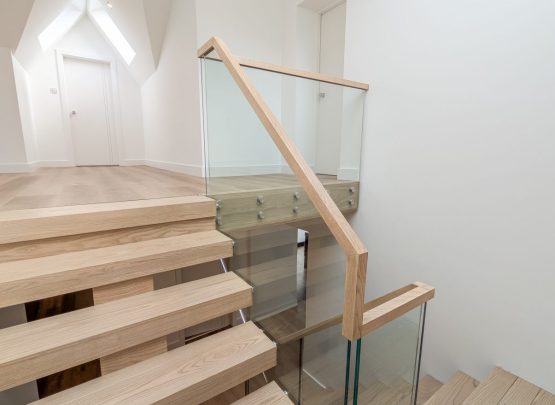
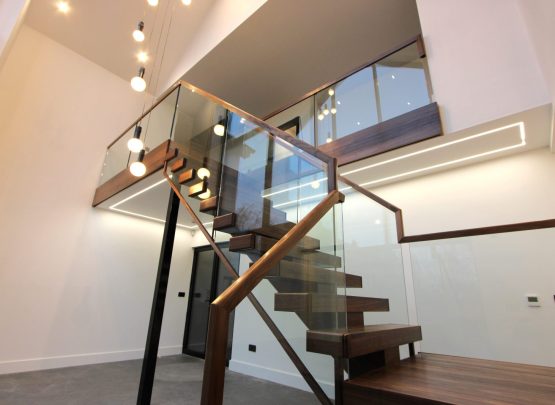
1. Minimalist Continuity: No Newels, Free-Standing Glass
This approach represents the most modern interpretation of a continuous handrail.
With no newel posts interrupting the line, the handrail appears to float, often supported by structural glass panels. The result is a clean, uninterrupted visual flow that aligns perfectly with contemporary architecture.
Key characteristics:
- Seamless, uninterrupted line with no vertical breaks
- Often paired with glass balustrades for transparency and light
- Emphasizes geometry and structure over ornament
- Creates a sense of openness and space
In this design, the “continuity” is not only functional but also architectural, allowing the staircase to feel like a sculptural element rather than a collection of parts. It reflects the idea that a continuous handrail can exist without reliance on traditional supports like newels.
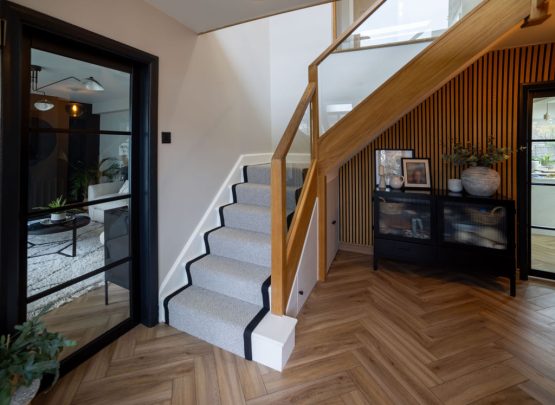
2. Continuous Handrail with Newels: Flowing Over Structure
This design balances tradition and continuity.
Here, the handrail flows over the tops of newel posts, creating the illusion that it rises directly from the floor and continues uninterrupted along the stair. Rather than stopping at each post (as in post-to-post systems), the rail passes over them, maintaining a smooth, graspable line.
Key characteristics:
- Handrail “flows” over newel posts
- Strong visual connection between floor, post, and rail
- Combines structural clarity with fluid movement
This is often referred to as an “over-the-post” continuous handrail, where the rail creates a single, unbroken surface despite the presence of structural elements .
The effect is subtle but powerful: the handrail feels like one continuous gesture, visually tying the staircase together while still expressing its construction.
3. Traditional Craftsmanship: Continuous Handrail with Fittings
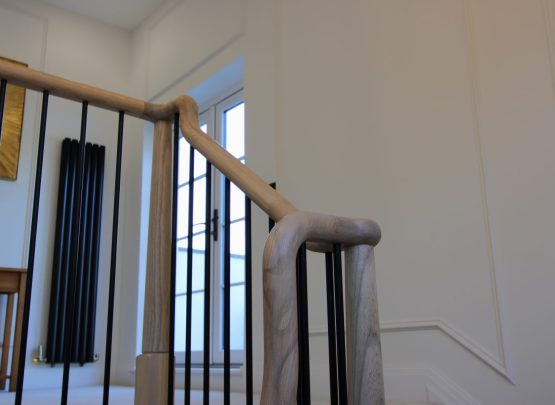
The third approach celebrates craft and detail, using continuous handrail fittings to achieve fluidity.
Rather than bending a single piece of timber, this method uses precision-made components—such as:
- Bends (horizontal direction changes)
- Ramps (vertical transitions)
- Volutes and scrolls (decorative ends)
These fittings are carefully joined to create a fully continuous, flowing handrail that navigates turns, landings, and level changes.
Key characteristics:
- Built from multiple components with matching profiles
- Allows for complex geometry and directional changes
- Highly customisable and traditional in appearance
- Requires skilled craftsmanship for accurate installation
Continuous fittings are specifically designed to create “a flowing, uninterrupted handrail” when combined with straight sections . This system has long been used in classical staircases, where elegance comes from both movement and detail.
Final Thoughts
Although each of these approaches looks very different, they all achieve the same fundamental goal: a continuous, uninterrupted handrail that improves both safety and design cohesion.
- Glass & no newels → pure minimalism and visual lightness
- Over newels → balance of structure and flow
- With fittings → traditional craftsmanship and expressive detailing
Ultimately, the choice depends on the architectural language of the space—but when done well, a continuous handrail always brings a sense of effortless movement and unity to a staircase.